This page has two halves. The first is one household’s account of paying full price for a duct cleaning in a Houston suburb and getting something less. The second is the checklist that account produced, built on what the EPA and the industry’s own standard say a complete job contains. The checklist is what this site holds the contractors it refers to.
What follows is a first-person account from one Houston-area household, written for this site. It describes one job at one house. It is not a claim about any company, and it is not a claim that this site does the work — it is the reason the site holds the line it holds.
The house was about eleven years old when I did a remodel on it myself, and by the time the drywall was sanded and the floors were in, the ducts had taken a year of it. I knew they needed cleaning. I did not go looking for a company; one came to the door, and the timing was right, so I said yes. The price was somewhere around $3,500, which I understood to be the top of the market for two systems, and I understood it as buying the whole job.
They were done in a few hours. I remember being pleased about that at the time. What I found afterward, under the registers they had pulled and put back, was the debris they had knocked loose and not caught — a line of it along the baseboard under every supply, a ring on the carpet under the returns, and in one room a small pile of the drywall dust I had paid to have removed, now on the floor instead of in the duct. Nothing had been sealed off. The plenum in the attic had not been opened. I never saw a machine that put the system under negative pressure, and I did not know at the time that I should have been looking for one.
I had paid the price of a complete source-removal cleaning for what was, mechanically, a register-by-register vacuuming with the loose material blown into the rooms. The money was not the lesson. The lesson was that I had no idea what the job was supposed to contain, so I had no way to tell that I had not received it — and that the price told me nothing, because a high price and a real job are not the same thing.
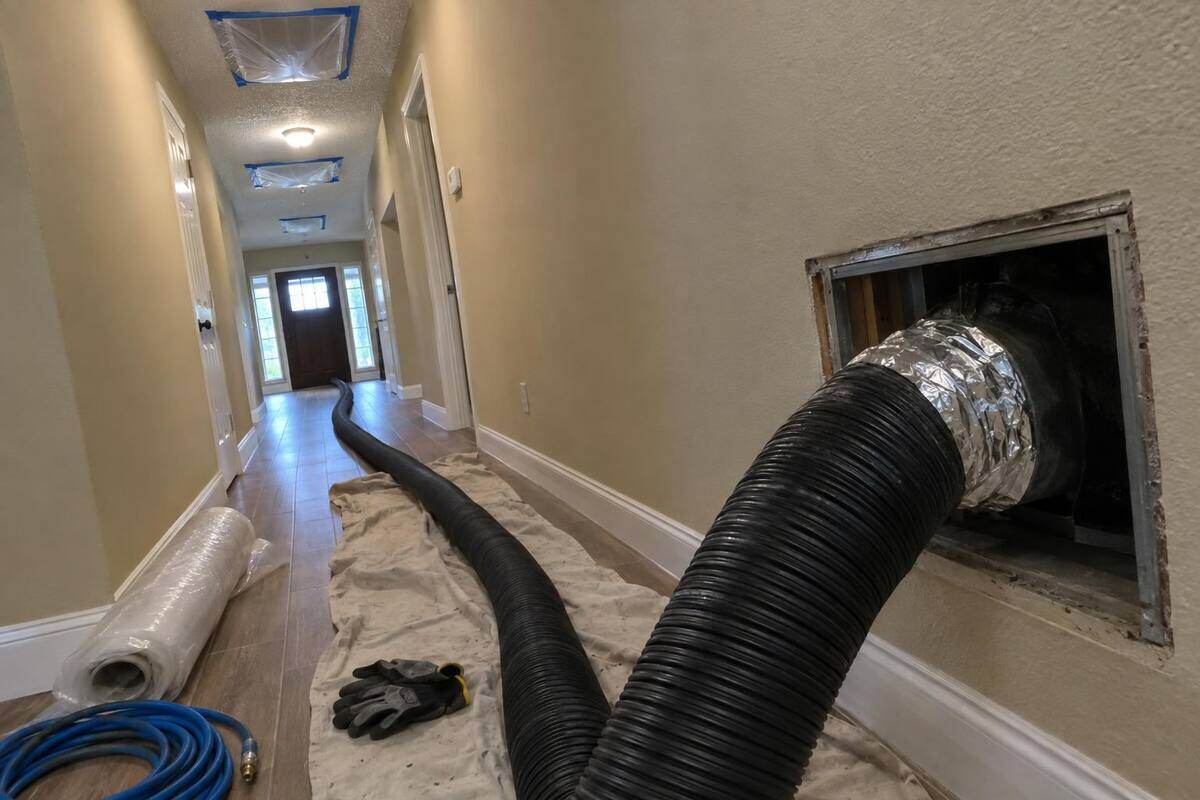
The EPA publishes a consumer checklist for judging a duct cleaning after the fact, and the National Air Duct Cleaners Association publishes the standard its members clean to. Between them, this is what the job is. Every item is something you can see, ask about, or time.
A truck-mounted or portable vacuum is connected to the trunk or the return plenum, and the whole system is pulled toward it for the entire job. This is the difference between source removal and redistribution. If there is no big hose taped into an opening, there is no negative pressure, and the debris being knocked loose is going into the rooms.
Registers not being worked are sealed with plastic or magnetic covers so the vacuum draws through the ductwork, not the house. Furniture near registers is covered. The drop cloths come out before the tools do.
Rotary brushes, air whips or compressed-air skipper balls run the length of each branch, toward the vacuum. Every supply. Every return. A crew that does the supplies and skips the returns has skipped the dirtier half of the system.
The supply plenum on top of the air handler and the return plenum below it are where debris settles. They are opened through existing access doors and cleaned. If a plenum has no door, cutting one and sealing it with a proper permanent panel is licensed work — it should be on the scope as such, not improvised.
Every removable register and grille is taken down, cleaned, and reattached. The boot behind it is cleaned. A register wiped in place is not the same thing.
Coil, blower, drain pan, cabinet interior, any cut-in access, any product applied inside the system: on the scope, these appear as the work of a Texas-licensed air conditioning contractor, or they do not appear. A duct crew that offers them is offering something it may not sell in this state.
Four to seven hours for one system in an ordinary house; most of a day for two. The industry’s own guidance and Houston’s Better Business Bureau both put a legitimate job at several hours. Ninety minutes is a symptom.
Nothing under the registers. Nothing on the carpet under the returns. Access doors reattached and sealed. The system runs, the filter is back in, and the filter is new if it was due. This is the item the account above failed on, and it is the easiest one to check.
We ask the contractors this site refers to for the same things the checklist asks for: negative pressure on every job, all supplies and all returns, plenums opened, a written scope that counts systems and openings and names the licensed items as licensed, and a duration that matches the work. We do not ask them to promise health outcomes, energy savings or allergy relief, because the EPA says duct cleaning has not been shown to deliver any of those, and a contractor who promises them anyway is telling you something about how they sell.
If your quote does not look like the checklist, send it back before the truck arrives, or send it here. The site would rather lose the referral than repeat the story at the top of this page in your house.
Systems, openings, plenums, duration, and who holds the license for anything past the grille. That is what a written scope from a contractor in your zone should show.
Call (346) 586-0541 Describe the Job Houston Duct