A separate job from the ducts, deliberately. A dryer vent carries hot, moist, lint-laden air from the back of the machine to the outside, and every foot of it collects what the lint screen misses. It is the smaller ticket on this site and the one with the clearest reason: lint in a hot duct is a fire-safety item, and a run that has never been brushed is holding years of it.
The transition duct is the short flexible piece behind the dryer, and it is where the trouble starts: it gets crushed when the machine is pushed back, kinks into an S, and fills first. The wall run is the rigid metal duct from the wall collar to the outside, anywhere from four feet in a garage laundry to twenty-five feet in a two-story house that vents through the roof. The termination is the hood or cap at the end, with a damper that is supposed to open when the dryer runs and close when it stops.
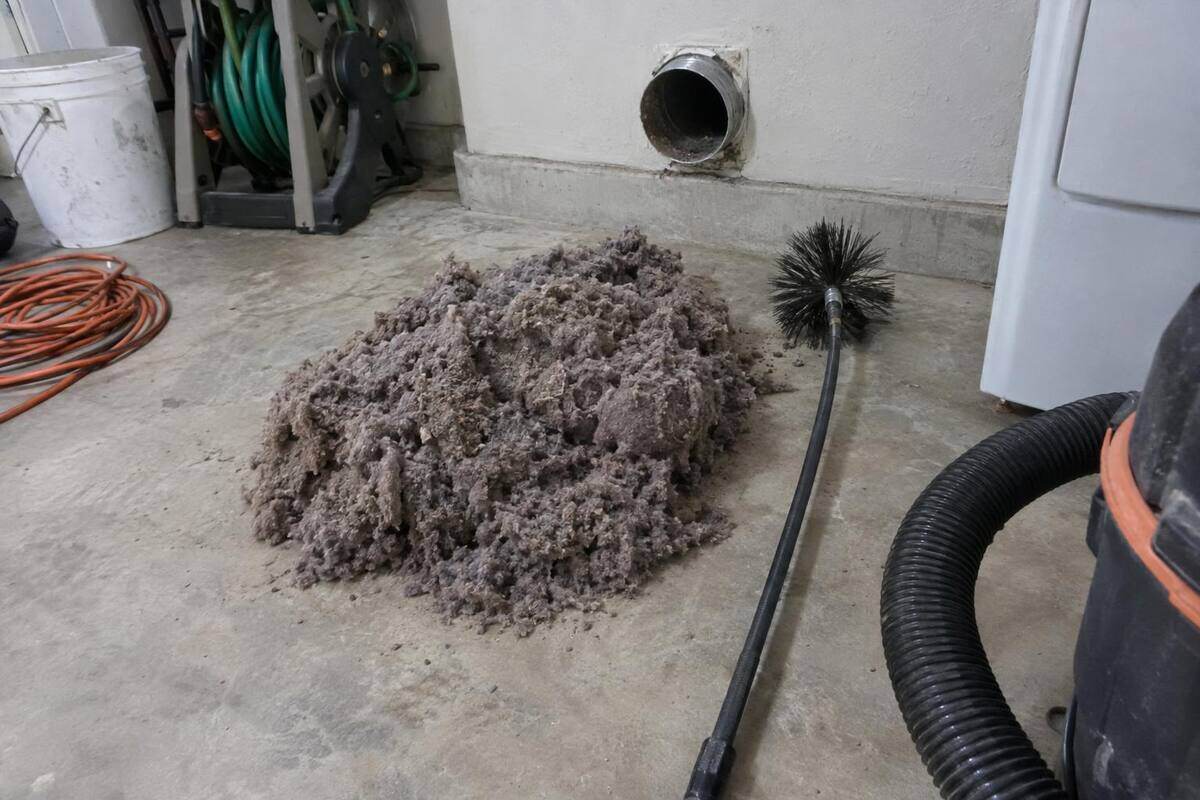
Lint stops wherever the air slows or turns: in every elbow, at the kink in the transition, at the damper. A run that has never been cleaned has a soft gray plug at each of those points and a fur coat along the rest. The dryer keeps running because dryers are built to; it just runs longer, hotter, and closer to the temperature at which lint ignites.
The dryer comes out from the wall and the transition duct comes off and is cleaned or, if it is crushed or is the old foil accordion type, replaced. A rotary brush on flexible rods runs the length of the wall run from the inside, with a vacuum on the room end catching what comes back; on a roof termination the crew goes up and works the cap from the outside as well. The termination is cleared, the damper checked for free movement, and any screen — which should not be there on a dryer vent — noted. The dryer goes back with a new or straightened transition and the run is tested for airflow at the outside end.
Forty-five minutes to an hour and a half for a wall vent; longer for a roof vent, which needs a ladder and a second pass from the cap. $99 to $189 through a wall in this market, and typically $150 to $275 through the roof. It is priced as an add-on to a duct cleaning because it is usually done on the same visit, but it stands on its own and is worth booking on its own.
Because the reasons for it are different and clearer. Nobody debates whether a lint-packed dryer duct should be cleaned; the debate on the duct side, about whether cleaning does anything for air quality, does not exist here. The symptoms are specific — the dryer takes two cycles, the laundry room gets hot and humid, the top of the machine is hot to the touch, the outside hood does not open when the dryer runs — and each has its own page on this site. And it is the visit that most often finds the bigger job: a crew that has the dryer out and a brush in hand is in a good position to look at the air handler in the next closet and say whether the ducts need anything. That is a fair conversation to have. It is not the reason to book the dryer vent; the lint is.
Unlike ducts, this one has an honest interval. Once a year for a household that does laundry daily or vents through the roof; every two years for a short wall vent in a small household. Sooner if the dryer is slowing.
A short wall vent, yes, with a brush kit from the hardware store and a vacuum. A roof vent or a long run with elbows is where a rod brush and someone on the roof earn their money.
No. Screens trap lint and birds nest behind them anyway. A dryer termination is a damper, not a screen; if yours has one, the crew should take it off and say why.
The vent is the age of the house, not the dryer. A new machine on an old run is the most common way a fifteen-year-old vent gets discovered.
The symptom most people blame on the dryer. Usually the vent.
Why two-story Houston floor plans put the dryer vent on the roof, and why those fail first.
A jammed damper or a nest behind the louvers is where most of the trouble starts.
Say whether it vents through a wall or the roof and which part of the metro. Same-visit pricing if the ducts are on the ticket too.
Call (346) 586-0541 Describe the Job Houston Duct