Walk a Cypress or Pearland subdivision built since 2000 and look at the roofs: nearly every one has a small hooded cap above the laundry. Upstairs or central laundry rooms have nowhere to vent but up, so the run goes through the ceiling, across the attic and out the roof deck. It is the longest, most restricted, least visible dryer vent configuration there is, and it is the Houston default.
Length, first. A wall vent from a garage laundry is four to eight feet with one elbow. A roof run from a central laundry is fifteen to thirty feet with two to four, and every foot and every turn is resistance the dryer has to push against. Dryer manufacturers rate their machines for a maximum equivalent length, and a long roof run with elbows is often at or past it from the day the house is built.
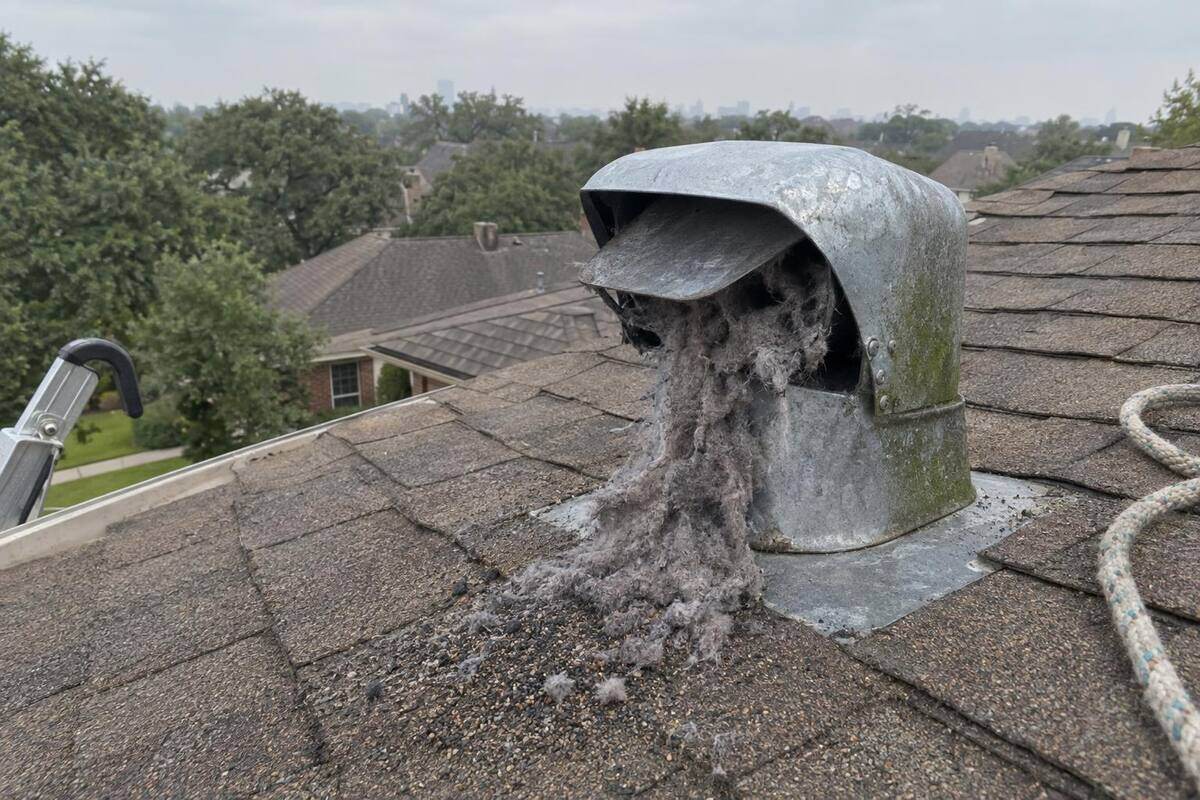
Then the cap. A roof dryer cap is a hood with a damper on the roof deck, twenty feet above anyone’s eye line. When it clogs, nobody sees the lint beard hanging from it; when a bird nests in it, nobody notices the flap has stopped closing; when the damper corrodes shut, the only symptom is downstairs, in a dryer that takes two cycles. And the run through the attic passes through 130°F air in summer, which does nothing for a duct already full of warm lint.
Finally the attic itself. A roof run should be rigid metal, sealed at the joints, and supported so it does not sag. A lot of Houston roof runs are flex, or a mix, with a sag between joists that collects a wet lint plug at the low point. That is a run that cannot be brushed clean and has to be replaced — which the crew should say when they see it.
From both ends. A rotary brush on rods works up from the laundry room, and a second pass comes down from the roof cap, with the cap removed, cleared, and its damper freed. Between the two passes the run gets its first full clearing in years and the lint comes out onto the roof, where it is bagged. The crew checks the run in the attic while they are up there for sags, disconnected joints and the wrong material, and reports it. A long run that has been done properly should show a strong, steady stream at the cap with the dryer running, and the crew should show you from the yard.
Longer and more expensive than a wall vent — typically $150 to $275 in this market — and worth doing annually on a household that uses the dryer daily. It is also the vent configuration where the “dryer takes two cycles” call most often ends in a real find.
Sometimes, if the laundry is near an exterior wall. That is a rerouting job for a handyman or HVAC contractor, and it makes every future cleaning cheaper. Worth asking about when the run is bad.
Manufacturers publish one for each machine, usually around 35 equivalent feet with each elbow counting as five. Many Houston roof runs are near that. Rigid metal, minimal elbows and a clean cap are what keep a long run working.
It is a sign the run is loaded and the damper is not closing. Stop using the dryer until it is cleaned. Not an emergency, but not a wait-until-spring either.
Transition, run, termination.
Roof runs are where that complaint most often ends in a real find.
Sixty-eight percent built 2000 to 2019, two-story, roof-vented.
It changes the time and the price, and it is the configuration most worth cleaning. The contractor covering your zone books the ladder with the brush.
Call (346) 586-0541 Describe the Job Houston Duct