The termination is the one part of a dryer vent you can see from outside, and it is where the run meets the birds, the wasps, the weather and the Houston humidity. A damper that does not close lets pests in; one that does not open lets nothing out. Most dryer vent calls, if you trace them back, started here.
A hood or cap with a damper that swings open freely when the dryer runs and closes flat when it stops. That is the entire specification. On a wall it is usually a plastic or metal hood with one flap or three louvers; on a roof it is a galvanized cap with a flap under the hood. No screen. A screen on a dryer vent traps lint on its mesh until the vent is closed, and the birds it was meant to keep out nest on the lint anyway. If your termination has one, it is either a bathroom fan hood that was used by mistake or a well-meant addition that needs to come off.
Houston adds two problems. Humidity and the salt-air belt near the bay corrode metal dampers until they stick, and the plastic ones go brittle in the sun and snap. And the bird pressure is real: starlings, sparrows and grackles look for exactly this kind of warm, sheltered tube in March, and a damper that has been propped open by lint is an invitation.
A nest behind the louvers announces itself as a dryer that suddenly takes longer in spring, sometimes with a smell. The crew removes the hood, clears the nest and whatever lint it was built on, checks how far back into the run it goes, and cleans that section. A wasp nest in a hood is a job for a can of spray at dusk before anyone puts a hand in. A damper jammed with lint is cleared and freed; a corroded or broken one is replaced, and the hood with it if it is the wrong kind.
Then the bird guard question. A proper dryer vent bird guard is a cage over the hood with openings large enough that lint passes and a bird does not — not a mesh screen. On a house with a history of nesting, or a roof cap that cannot be inspected without a ladder, it is a reasonable addition. On a wall hood you can see from the driveway, a damper that closes is usually enough. The crew should be able to say which, and should not sell a guard onto a hood that simply needed its flap freed.
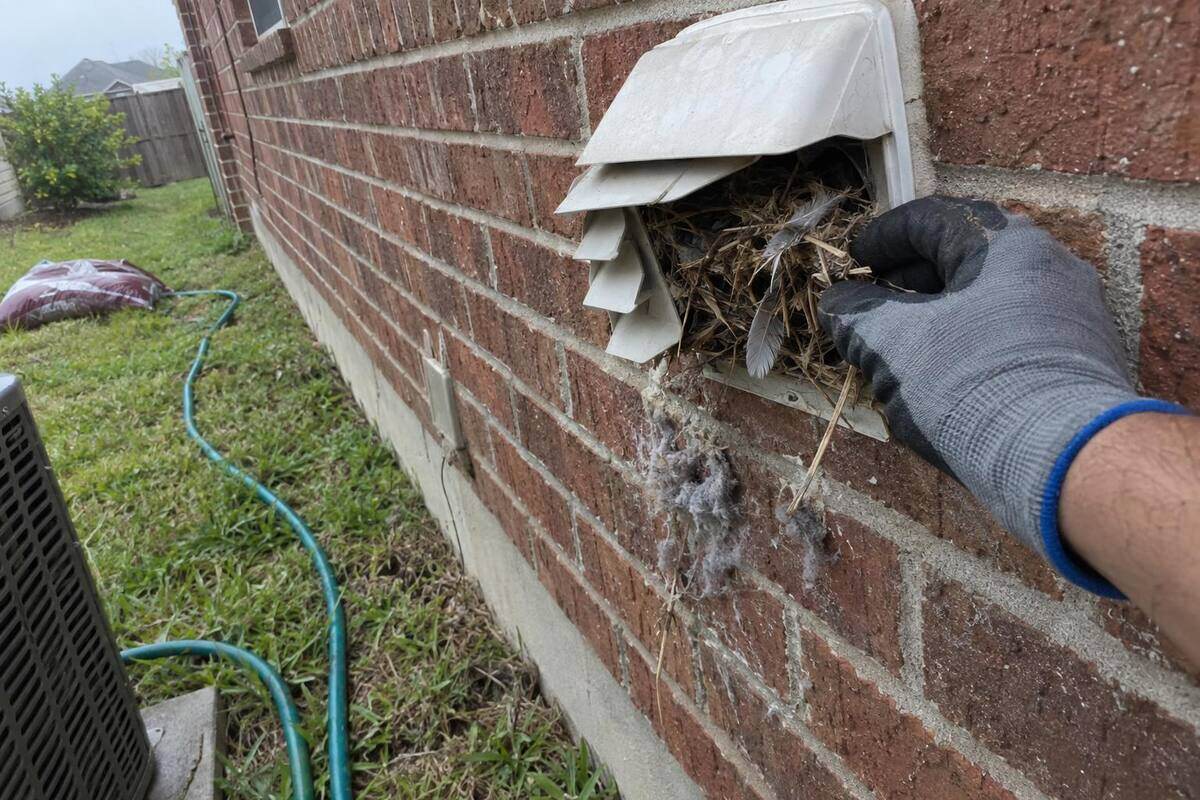
Watch it after the dryer stops. It should drop flat within a few seconds. Propped open means lint or corrosion, and it means anything outside can walk in.
For the bird, possibly; for the house, it means stop using the dryer until the run is cleared. A dead bird in a hot lint-filled duct is the scenario the whole page is about.
A wall hood, yes, if the old one comes off cleanly and the new one matches the duct diameter. A roof cap involves flashing and shingles and is better left to whoever is already up there.
The termination is the end of a run that probably needs the rest done too.
The termination nobody can see.
A stuck damper reads as a slow dryer.
Say which, and which part of the metro. The contractor covering your zone clears it, fixes or replaces the termination, and tells you honestly whether a guard is worth adding.
Call (346) 586-0541 Describe the Job Houston Duct