The supply plenum sits on top of the air handler and feeds every run; the return plenum sits below it and receives everything the returns pull back. In a Houston attic both are ductboard boxes wrapped in foil, and both are where the heavy material ends up. They are also the part of the system a quick job never opens.
Air leaves the air handler fast and hits the supply plenum, a box roughly the size of a small refrigerator, where it slows down before splitting into eight or twelve or sixteen flex runs. Slow air drops what it is carrying. Over years the floor of the plenum and the collars where the runs attach build up a layer of whatever got past the filter, and in a house that has been through a remodel, that layer is drywall dust. On the return side the plenum is dirtier still, because it is upstream of the filter.
Ductboard — compressed fiberglass with a foil face — is what nearly every Houston plenum is made of. It is cheap, it is quiet, and its inside surface is bare fiberglass, which holds dust the way carpet does. It cannot be scrubbed. It is cleaned with contact vacuuming and soft agitation under negative pressure, and a plenum whose fiberglass has started to break down and shed is a replacement, not a cleaning.
A plenum is cleaned through an access door. Some systems have one; many Houston systems do not, because nobody planned on ever opening the box. Where there is a door, the crew opens it, cleans, and reseals it. Where there is none, one has to be cut, and this is the point where 16 TAC §75.100 stops the unlicensed job: cutting the ductwork or a plenum is air conditioning contracting, and the cut has to be closed with a proper sealed door by a licensed contractor. On a written scope that shows up as a licensed line item with the contractor named. A duct crew that cuts a hole, cleans through it and tapes it shut has done licensed work without a license and left you a leak.
The trunk lines — the larger runs between the plenum and the branch takeoffs, on systems that have them — are cleaned the same way the branches are: from the far end toward the vacuum, with the brush sized to the duct. Many Houston systems have no trunks at all, just a plenum with runs radiating from it, which makes the plenum matter more.
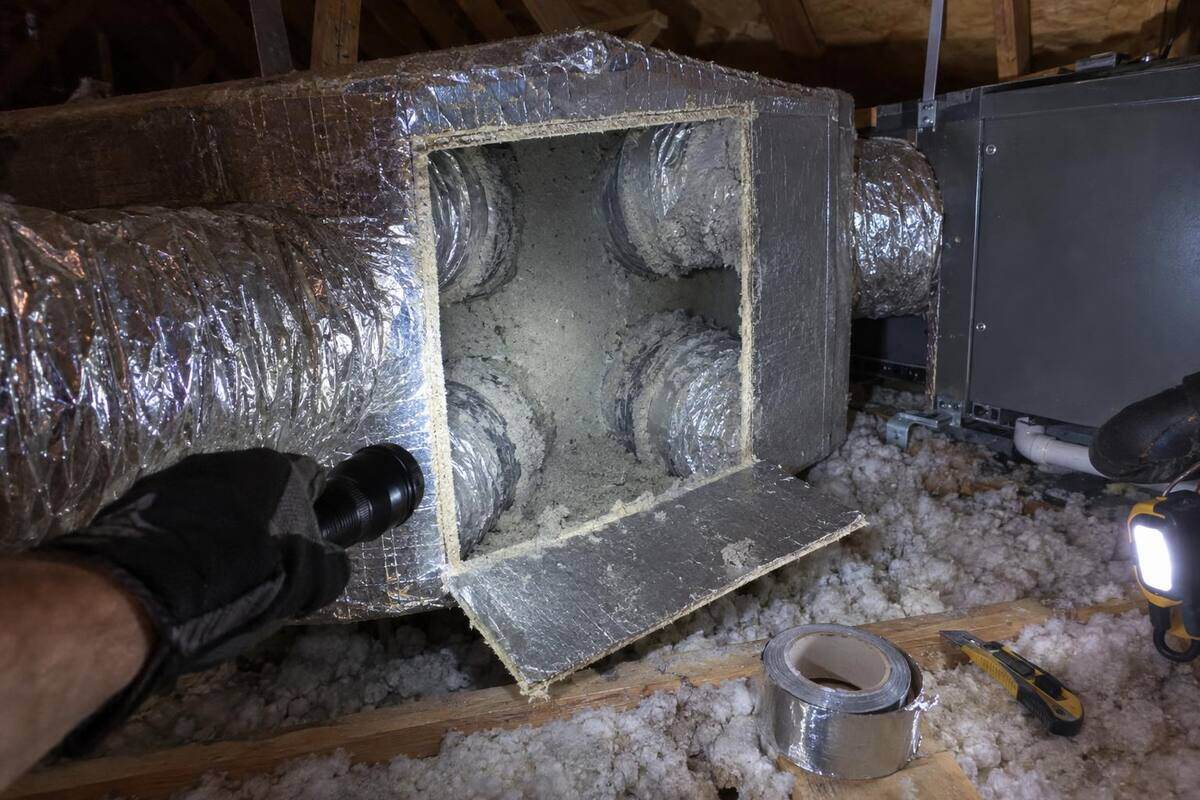
Drywall dust after a remodel, in a layer thick enough to write in. Insulation fibers pulled in through unsealed boots. Rodent droppings and nesting material where a run was chewed open. Occasionally construction debris that has been in the plenum since the house was built — a lunch wrapper, a sawn-off end of a stud, a whole roll of tape. And, after water has been in the attic, wet fiberglass that has started to grow, which ends the cleaning conversation and starts a replacement one.
The plenum is the best evidence of whether a system needed cleaning at all. Ask the crew to photograph it open before and after. A contractor who cleans plenums will not mind; one who does not open them will have no picture to show.
Look at the foil-faced box on top of the air handler for a square panel with screws or a metal frame. No panel means no door, and cutting one is a licensed line item on the scope.
Applying any disinfectant inside the system is licensed work in Texas, and the EPA says no chemical biocide is registered for use in internally insulated ductwork, which ductboard is. Decline it unless a licensed contractor can name the product and the registration.
Shedding fiberglass means the plenum is past cleaning and needs replacing, which is HVAC work. A good crew stops and tells you rather than cleaning something that will keep shedding.
Plenums are one of eight items; here is the rest.
Cut-in doors, coil, blower and sanitizing, and who quotes them.
Item four is the plenum. Ask for the photograph.
That single question sorts most Houston duct cleaning quotes into two piles. Say where the house is and the contractor covering your zone answers it in writing.
Call (346) 586-0541 Describe the Job Houston Duct