The job every price range on this site describes. One air handler at a time, the entire distribution system is put under vacuum, every branch is agitated toward it, and the plenums come open. It takes most of a day and it is the only version of this service that is worth paying for.
The phrase is used by everyone from the $13 coupon to the NADCA-member operators charging $1,500 a system, so on its own it means nothing. Here it means the scope the industry’s own standard describes: the entire air distribution system for each air handler, cleaned by source removal. Source removal is the term of art for putting the system under continuous negative pressure with a truck-mounted or portable vacuum and then agitating every run — rotary brush, air whip or compressed-air skipper ball — so that what comes loose is pulled to the machine rather than blown into the house.
Every supply run. Every return run. The supply plenum on top of the air handler and the return plenum feeding it. The trunk lines between them. The registers and grilles, taken down and cleaned rather than wiped in place, and the boots behind them. For a Houston house that is a system living in the attic, so most of the work happens up there, with the machine on the hallway floor and a hose taped into the largest return.
A one-system house of ordinary size runs four to seven hours. A two-story with two air handlers, which describes most of the suburban stock built since the mid-1990s, runs most of a day. The time is not padding; it is the sum of covering every register, working every run from the register end toward the plenum, opening and cleaning two plenums per system, and cleaning up. Houston’s Better Business Bureau told a local television investigation that a legitimate job takes at least five hours, which matches the industry’s own guidance. A crew that leaves after ninety minutes has done the supplies from the room side and nothing else.
Duration is the easiest item on a written scope to check and the one most often missing from it. Ask.
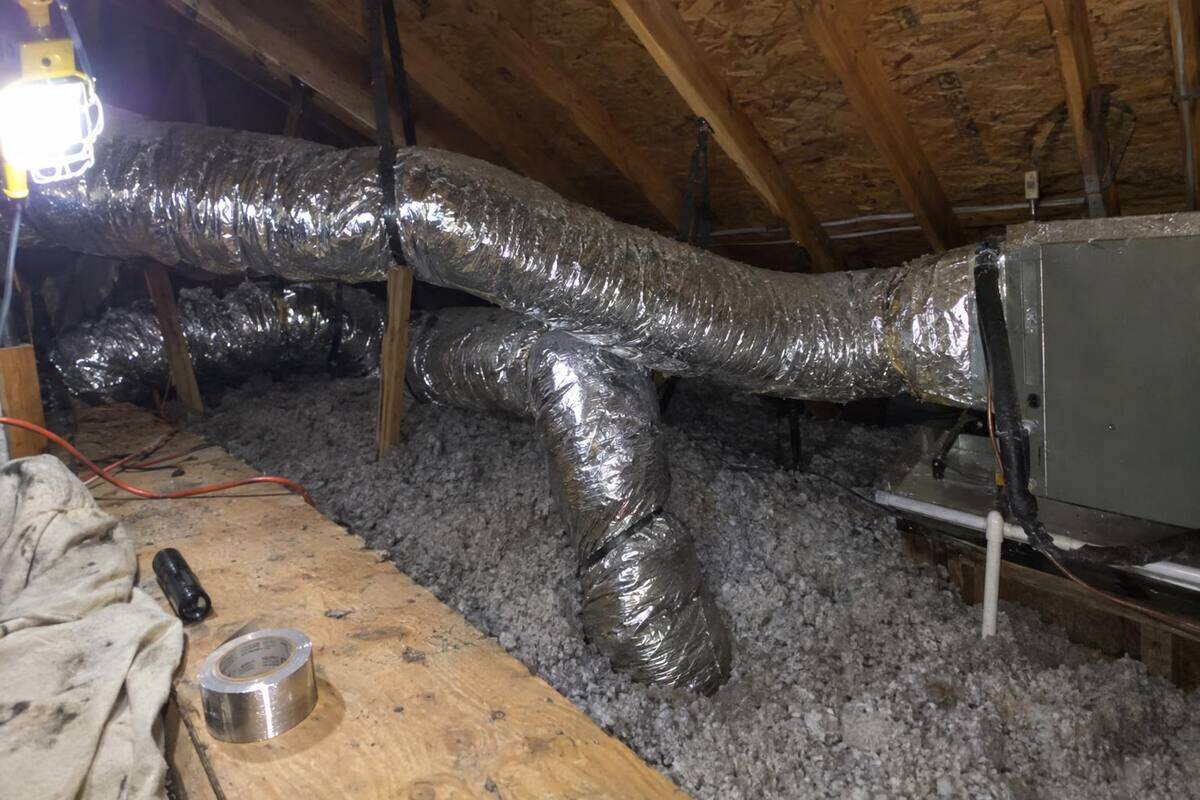
Nearly every house here is slab-on-grade with the air handler and all of the ductwork in the attic. The duct is flexible, internally insulated and draped between rafters over loose blown-in insulation, which means it sags, kinks and gets crushed where later work — a cable run, a new light, a storage platform — landed on it. Cleaning flex duct takes a lighter touch than metal: the brush has to be sized to the run and driven with the helix, not against it, or it tears the inner liner and the job becomes a replacement.
The attic also decides access. A system on a decked walkway with an existing plenum door is the easy case. One buried under stored boxes, or with a plenum that has never had a door cut, adds time, and cutting the door is licensed work under 16 TAC §75.100 that has to be on the scope as such. See the plenum page.
The evaporator coil, the blower wheel, the drain pan and the inside of the air handler cabinet are not duct cleaning in Texas; they are air conditioning contracting and need a TDLR license. Neither is any disinfectant, anti-fungal or “sanitizer” applied inside the system. A whole-home cleaning quote that includes those should show them as separate lines with the licensed contractor named, or it should not include them. How that part is handled.
Also not in this job: ducts that have been wet. Flooded flex duct is replaced, not cleaned. The flex duct page is the one to read if the house has been through water.
Count the cabinets in the attic, or the thermostats. Most single-story Houston homes and older two-stories have one; most two-story homes built since the mid-1990s have two, one per floor; large homes have three. Each one is its own plenums, returns and hookup, and the quote is built per system.
Yes, for the plenums and to check the runs. A clear path to the air handler and a decked walkway make the job shorter. If the attic is full, say so on the call; it changes the time.
For the walkthrough at the start and the check at the end, yes. The end is when you look under the registers and at the plenum doors before the truck leaves.
Not unless it is on the scope, and it should be if the dryer has not been done in years; it is a small addition to the same visit. The dryer vent page.
Drywall dust is the clearest reason on this site to do this job, and it takes longer than ordinary dust.
Flex past twenty years, or flex that has been wet, is a replacement conversation, not a cleaning.
By systems, by supplies and returns, with the licensed items shown separately.
Say how many air handlers and which part of the metro. The contractor covering your zone counts the openings and puts the scope in writing.
Call (346) 586-0541 Describe the Job Houston Duct