The single most common dryer complaint in Houston, and the one most often diagnosed wrong. A dryer that used to dry a load in fifty minutes and now needs two runs has not, usually, worn out. It is pushing hot, wet air into a duct that cannot carry it away, and the moisture is going back into the clothes. Five minutes at the outside hood tells you which.
Start the dryer on high heat with a load in it and go outside to the termination — the hood on the wall or, if you cannot find one, the cap on the roof, which you can watch from the yard. A clear vent pushes a steady, warm, obvious stream you can feel from a foot away and the damper stands fully open. A restricted vent pushes a weak, warm breath, the damper flutters or barely lifts, and there may be lint hanging from the flap. If nothing at all comes out, the run is blocked or disconnected somewhere between the machine and the outside.
Then feel the top of the dryer after twenty minutes. Hot to the touch means the heat is staying in the machine because the air is not leaving it. Feel the laundry room: humid and warm means the same thing. A dryer that is genuinely failing — heating element, thermostat, belt — usually fails differently: no heat at all, or a drum that does not turn.
In order of how often it turns up: the transition duct behind the machine crushed flat when the dryer was pushed against the wall; a lint plug at the first elbow inside the wall; a termination damper stuck shut with lint or a nest; and, on two-story houses, a long roof run that has simply filled up over ten years because nobody could see the cap. Two of those you can fix yourself in an afternoon. The other two are what a dryer vent cleaning is for.
One more that is not the vent: a lint screen that is clogged with fabric-softener film. Wash it with dish soap, and if water beads on it afterward, that is your two-cycle problem right there.
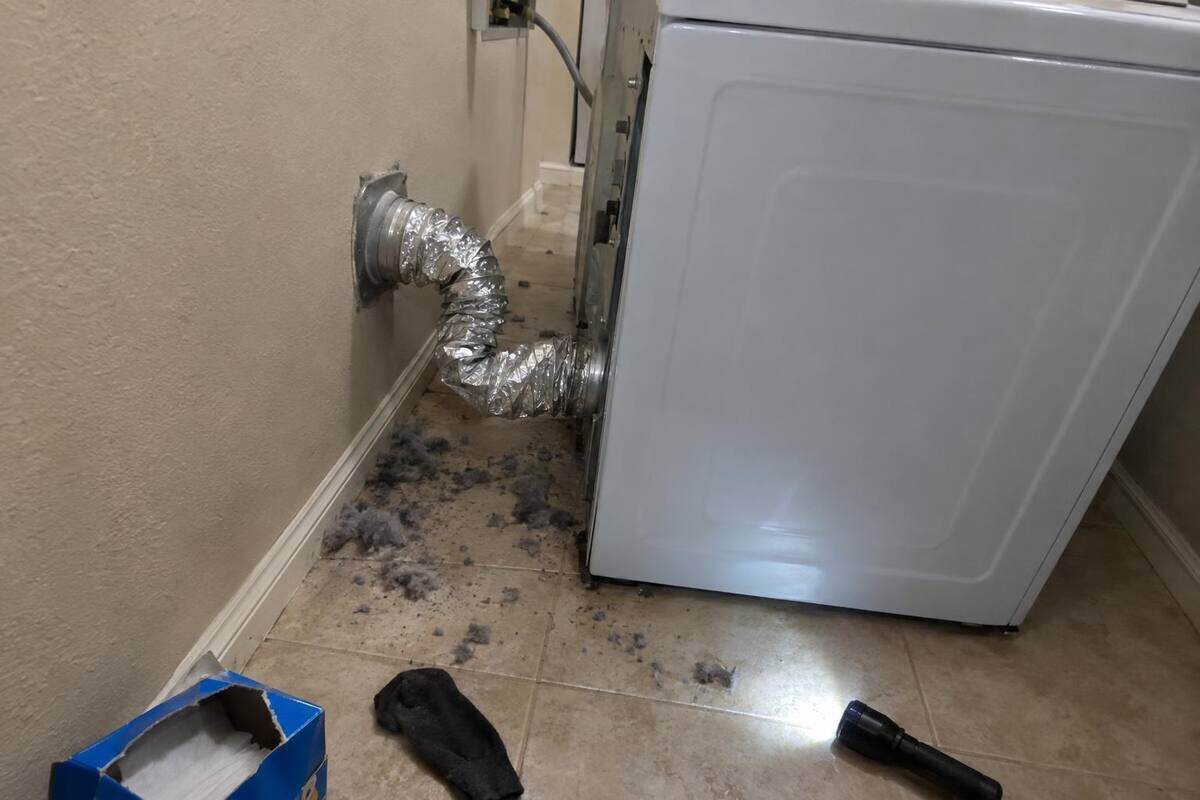
A dryer running two cycles is a dryer running at the top of its temperature range for twice as long, with lint at every restriction. That is the mechanism of a dryer fire, and it is why this site treats the vent as a safety item rather than a convenience. It also doubles the gas or electricity the dryer uses and shortens the life of the heating element. The cleaning costs less than one repair call for the dryer, and it is the more likely fix.
Leave the dryer off until the vent has been looked at if the outside test showed nothing coming out. The wait costs nothing.
That is the vent. Appliance technicians check the machine, not the run in the wall, and a fine dryer that will not dry is the textbook restricted-vent case.
Look on the roof for a small hooded cap, usually above the laundry room. Two-story Houston plans vent through the roof far more often than through a wall. If it is not on the roof or a wall, it may be venting into the attic, which is a problem on its own.
Yes, and it should be, with a semi-rigid metal one rather than the foil accordion type. Pull the dryer forward two inches more than you think it needs so it stays straight.
Transition, run, termination, $99 to $189 through a wall.
Longer, more elbows, a cap nobody looks at.
Jammed dampers and nests at the hood.
Say so, and whether it is a wall or roof vent. The contractor covering your zone books it as a vent cleaning, not a dryer repair.
Call (346) 586-0541 Describe the Job Houston Duct